

I'm So Happy I'm Not 17: On Olivia Rodrigo's SOUR and Gendered Expressions of Rage

Hello, Internet. I come to you with thoughts.
Confession: I spent an hour writing this the first time, finished it completely, and then left the page to get the URL to an earlier post I referenced. Only, I never titled the piece, and Wix doesn't save a draft without a title, so we're starting over. An exercise in surrender, if you will. So here I am again, with two days of distance from the original post. Let's hope this one comes out even better.
If you have access to WiFi and a music streaming service (I know you have at least the WiFi, because you're reading this), you've most likely listened to Olivia Rodrigo's debut album, SOUR. I would classify it as An Objectively Good Pop Album with pretty much no skips. That last part is my opinion– at the risk of being crucified, I'd argue that "driver's license" is the skip. Maybe that's just because I don't have one and it's actually just my jealousy seeping in, but the song was just a tiny bit boring. Now, "good 4 u"? Absolute banger.
As I discussed a bit in my last post, I didn't use to listen to much pop music. I actually avoided it at all costs, thinking that by virtue of it being mainstream, I couldn't associate with it. God forbid I enjoy something; we'd have a whole PR crisis on our hands: "Local 20-Something Compromises Tediously Constructed Indie/Alt/DIY Persona Just To Sing The Chorus To Ariana Grande Song." The horror.
Anyway. Despite knowing nothing/very little about music production, both as a noun and a verb, the somewhat genre-bending combination of dreamy bedroom pop and mid-2000s pop-punk present in SOUR is what held my attention. Rodrigo takes lyrical cues from icons such as Taylor Swift and Lorde, and tracks like "hope ur okay" seem to have the same instrumental punctuation, wavy synth, and ASMR vocals as Billie Eilish's "8" and "listen before i go". Her music is very much pop music.
But, on a few of my favorites like "brutal" (duh.) and "good 4 u", Dan Nigro (her producer) leans heavily into the more 'emo' elements of SOUR's sound. Rodrigo's narrative songwriting displays true vulnerability, renewing and reframing the classic breakup song formula by capitalizing on a different emotion than we're used to: anger.
In her review on NPR, Lindsay Zoladz reflects upon adolescence soundtracked by testosterone-fueled pop punk music of the early aughts There was no shortage of anger or heartache in the music itself, but it was almost always directed at the girl who broke the lead singer's heart. "In these songs," Zoladz writes, "she was often actively vilified, blamed for the Lead Singer Boy's every earthly woe — and not infrequently the star of his violent revenge fantasies." And sure, we had some good times with Hayley Williams and Avril Lavigne, and even Taylor Swift's "Picture to Burn", but the overt misogyny in pre-2010s alt songs left little to no room for some good ole fashioned riot grrrl rage.
I'm gonna talk about 2012-2016 Tumblr again. The attitude towards women and emotional expression that site perfectly complimented and reinforced misogynistic narratives found in popular media. I grew up with My Chemical Romance and Bring Me The Horizon, sure, but my other favorites were artists like Marina and the Diamonds, and the infamous Lana Del Rey.
If you know, you know.
If you don't know, allow me to explain: these women dominated the sad-girl-heartbreak genre. Not a single one of their songs (at the time) could pass the musical version of the Bechdel Test. Instead of being indignant and vengeful and raw in their break-up stories, the lyrics to their songs reinforced a kind of passive absorption of hurt; they focused their angst inward, blaming themselves for being women with feelings.
This reminds me of a conversation during a WGSS class: we discussed how emotional expression is not inherently, but socially gendered. We were focused, in this instance, on anger in particular. We came to the conclusion that, aside from the gentle push towards athletics, women are rarely afforded outlets for expressing anger.
I mean, we know this, but still– when was the last time you saw a woman get, like, really fucking angry and punch something? We were taught to get really angry and channel all that energy into either hating ourselves for being women or pulling some elaborate Gone Girl scheme. The problem (speaking heterosexually) was never the boy– he was allowed to have boundaries. You, on the other hand, were just a girl. This is the price you pay.
Or, it was. And that's what I admire about Rodrigo's music– neither her subject matter nor her teenage-girl angst is inherently new or original, but it reframes the narrative and removes the blame (self- or socially inflicted) from herself as a byproduct of being feminine. She is a whole person, she is hurt, and she's gonna sing/scream about it, end of story. No vilification of "the other woman," no palatable reduction of her emotions, just some catchy songwriting and a producer that knows how to make her sound absolutely amazing.
If you haven't streamed SOUR yet, listen to it. Or don't. Maybe it's not anything really that special, but I'm happy I get to hear and appreciate this as an adult instead of a teenager who would definitely think they're too cool to listen to pop music. I do still feel like I was owed a teenage dream as well, but maybe I'll find, like, some version of that in my 20s. But yeah, thank god I'm no longer 17. I'll leave you, dear reader, with this Tweet that not only resonates with this piece, but also with me, on a fundamental level.
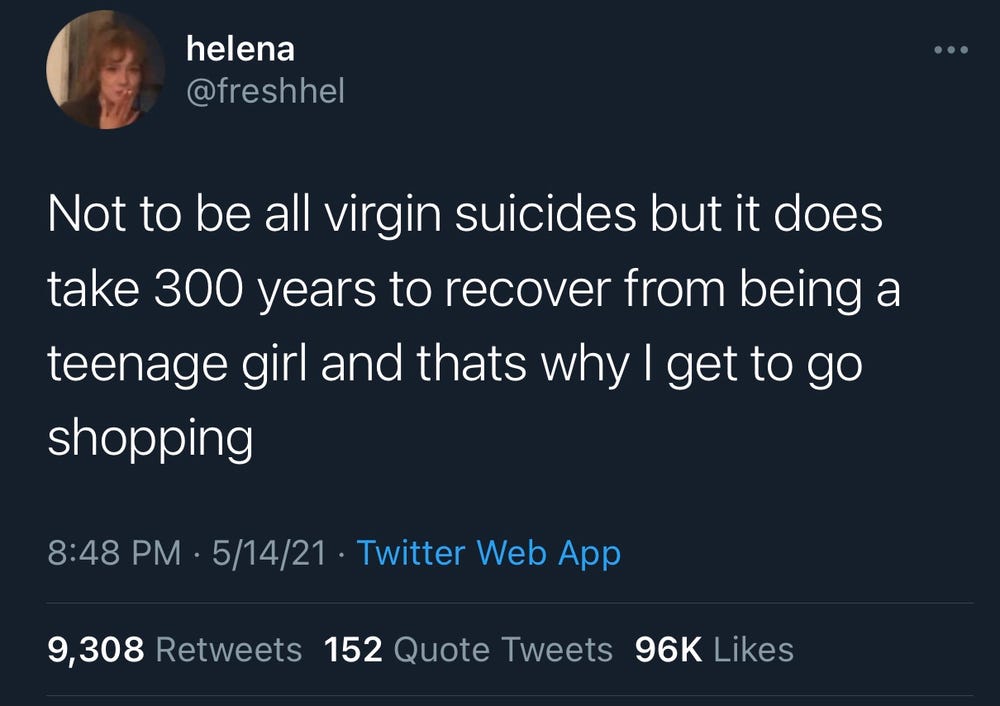
So, with that, I'll draw this all to a close. I think this one was a little better than the first draft. And my computer is operating within an inch of its life right now. This is The Universe asking me, kindly, to shut up and go to sleep. As always, thanks for reading. I'll see you soon.